
UP debuts public service podcast featuring alum and journalist Atom Araullo
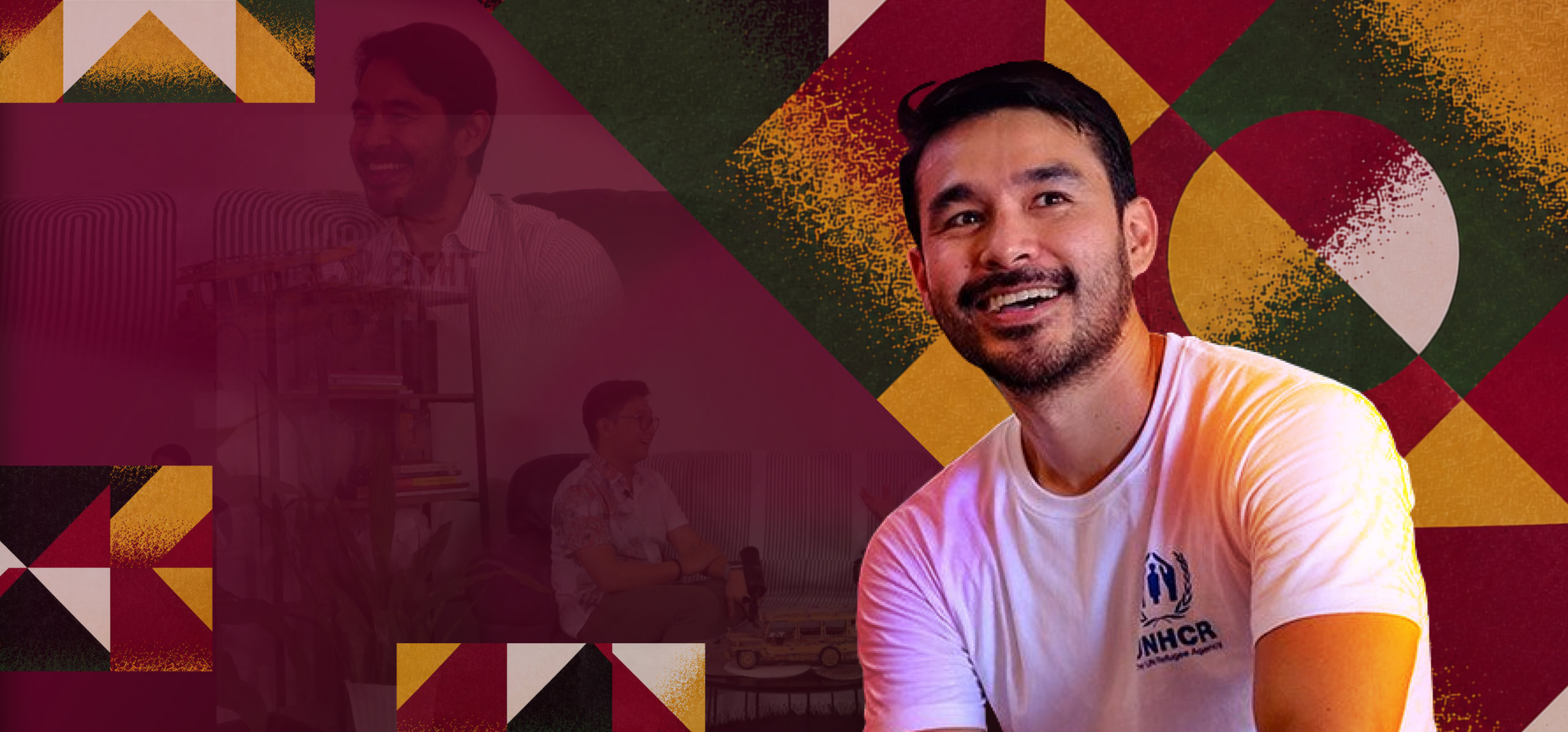
The premiere of Padayon, UP! podcast welcomes back broadcast journalist Atom Araullo to his alma mater, where he explored his journey from an Applied Physics major to a prominent figure in Philippine media.
The University of the Philippines’ new video podcast, Padayon, UP!, launched its pilot episode with a guest who makes a debut feel like both a homecoming and a statement of purpose. Award-winning broadcast journalist Atom Araullo (BS Applied Physics, UP Diliman, Class of 2005) sat down with host Assistant Vice President for Public Service Mark Lester del Mundo Chico in the Padayon UP Public Service Office for a conversation about public service, what it’s all about, and what it really means to serve.
The podcast’s name is a Bisayan word meaning “to move forward,” and it is also, fittingly, the name of UP’s own Public Service Office. The pilot episode took that shared name as its central question: what does public service actually look and feel like from the inside? Atom, who has spent two decades covering the Philippines from its typhoon zones to its sugar cane plantations, turned out to be precisely the right person to answer it.
Bilang iskolar ng bayan, mapapatanong ka talaga — ano ba ‘yung kapalit nito?
Na pinag-aral ako nang libre, in the best schools. [...] Anong kapalit noon?"Atom Araullo, Padayon, UP! Episode 1
Atom Araullo, a graduate of both Philippine Science High School (Pisay) and the University of the Philippines, has lived most of his life as an Iskolar ng Bayan. In the podcast episode, he revisits a commencement address he once gave to Pisay graduates, arguing that the true measure of an alumnus lies not in the prestige of their school but in their contribution to society. This sense of gratitude for his education often prompts him to ask, “ano ba ‘yung kapalit nito? Na pinag-aral ako nang libre, in the best schools […]. Anong kapalit noon?” For Atom, the answer is paglilingkod sa bayan, a commitment to public service that took root early in his youth and continues to serve as his professional and personal compass.
WHAT'S INSIDE?
Also Read:
HOW THE EARLY ATOM WAS FORMED
Long before he was the award-winning journalist documenting environmental issues, Atom was a shy kid from an activist family who was pushed onto a stage. In third grade, he was cast as the lead in a stage production of Charles Dickens’ Oliver Twist by the Ateneo Children’s Theater (ACT). At the time, few people could have guessed how significant that role would eventually become in shaping his future path. “Lagi kong nababanggit—kaya ako nag-ACT, kasi mahiyain akong bata,” he shares, “kung hindi ako napilitang mag-socialize, napilitan ng tatay ko na maging komportable on stage, siguro iba ‘yung mga naisip kong potential path na tahakin.”
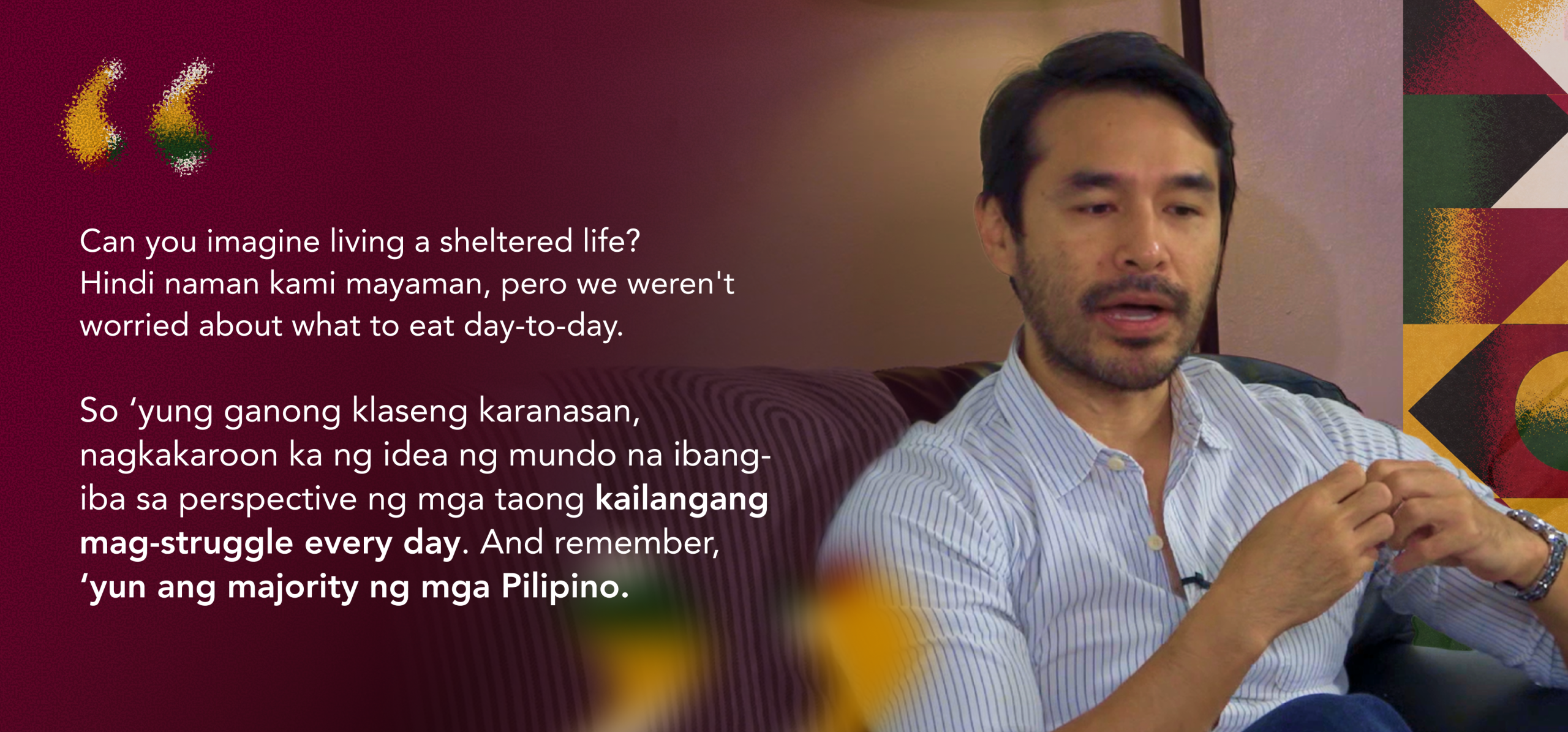
Atom’s time in children’s theater eventually led to his involvement in 5 and Up, a youth-oriented infotainment show by Probe Productions and Philippine Children’s TV Foundation. This exposure expanded his perspective, revealing diverse social realities far removed from his own experience. “It certainly widened my world,” he recalls, “Can you imagine living a sheltered life? Hindi naman kami mayaman, pero we weren’t worried about what to eat day-to-day. So ‘yung ganong klaseng karanasan, nagkakaroon ka ng idea ng mundo na ibang-iba sa perspective ng mga taong kailangang mag-struggle every day. And remember, ‘yun ang majority ng mga Pilipino.”
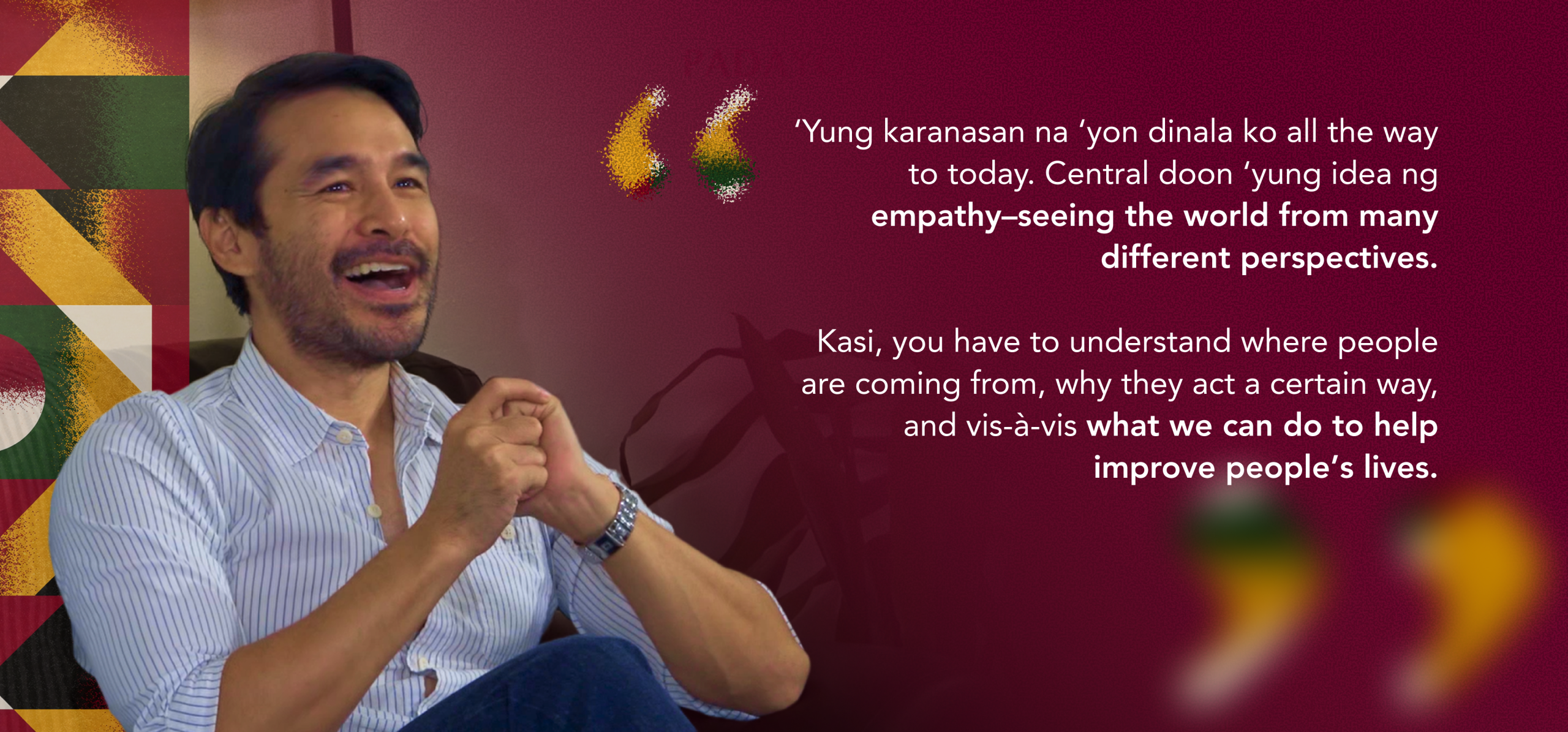
Reflecting on the responsibility that comes with his upbringing, he emphasized the necessity of engaging with different realities: “So importante, para sa mga tulad natin na merong privilege na umapak sa labas ng mundong ‘yon dahil mas maiintindihan mo kung bakit ganito ang Pilipinas, ganito ang mundo kung nakikita mo ‘yung buhay ng ibang mga tao.” These early insights eventually formed the foundation of his career in media. “‘Yung karanasan na ‘yon dinala ko all the way to today. Central doon ‘yung idea ng empathy–seeing the world from many different perspectives,” he adds. “Kasi, you have to understand where people are coming from, why they act a certain way, and vis-à-vis what we can do to help improve people’s lives.”
A further vital influence came from his parents, both UP graduates, whose perspectives were forged by political turbulence and extreme poverty during the martial law era. Atom noted that they served as his connection to a time of intense student activism, helping him realize that the role of the youth extends beyond academic and professional success to include a duty to serve the people. “Sila ‘yung naging link ko doon sa panahon na ‘yon,” Atom said, “kung kailan naging very active ‘yung mga estudyante at naintindihan nila ‘yung papel ng mga kabataan: na hindi lang basta mag-aral nang mabuti, maging successful sa kanilang propesyon, kundi mag-ambag sa lipunan.”
THE ACCIDENTAL PHYSICIST
Atom’s path through UP Diliman was, by his own account, somewhat accidental. Initially, he planned to pursue Chemical Engineering to stay with his high school friends, playfully imagining students as “gumagawa ng mga chemicals.” However, he quickly discovered the field was not fit for him. “Sabi ko, ‘Ayoko po mag-Chem Eng’g pala. Pwedeng Physics na lang?,” he recalls. After visiting the registrar to switch majors, he joined the Department of Physics, noting with a laugh, “[kasi] hindi quota course ang [applied] physics.”
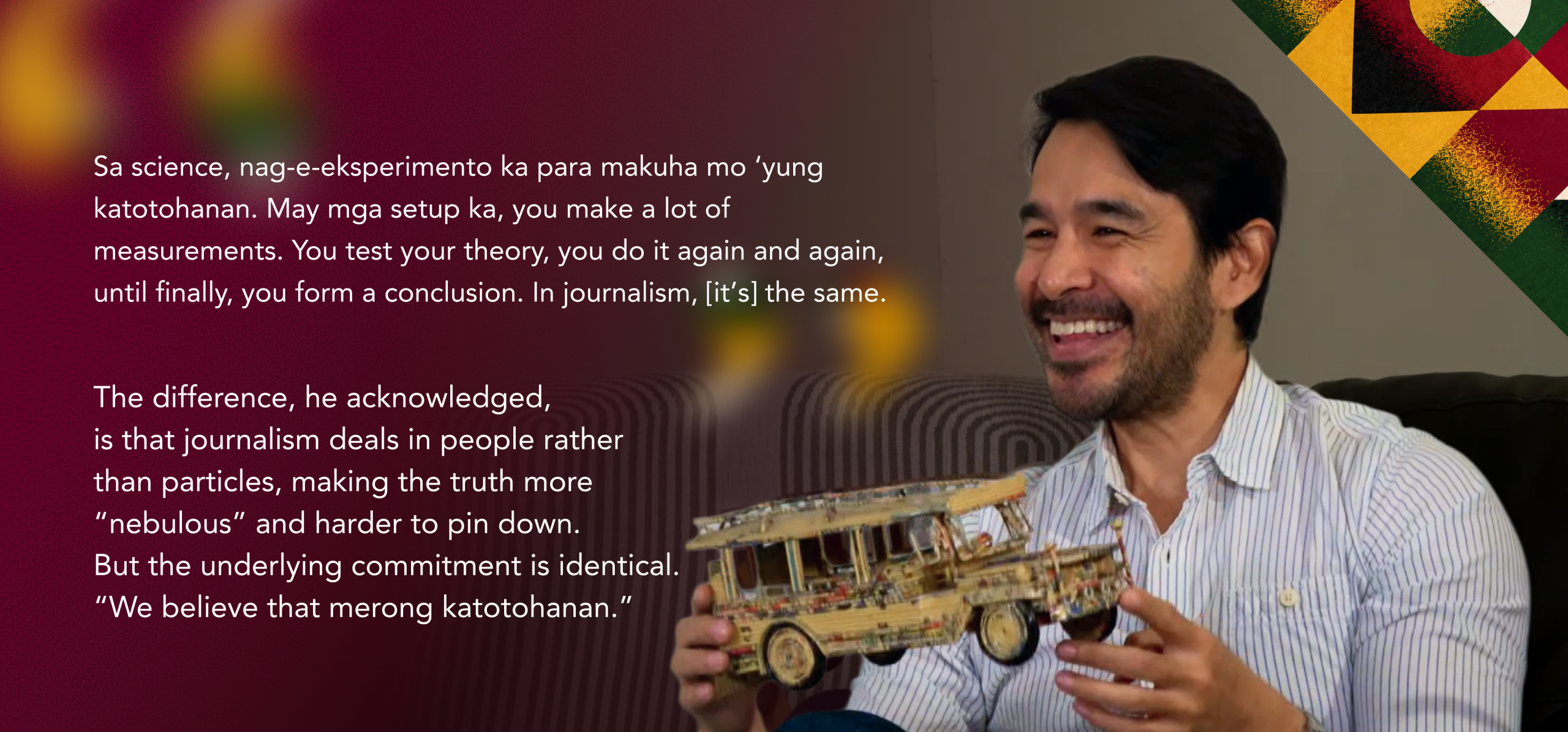
But the rigors of an Applied Physics degree turned out to matter enormously, even for someone who would never practice it. He is emphatic about the connection between scientific training and journalistic practice. “Sa science, nag-e-eksperimento ka para makuha mo ‘yung katotohanan,” he explained in the episode. “May mga setup ka, you make a lot of measurements. You test your theory, you do it again and again, until finally, you form a conclusion. In journalism, [it’s] the same.” The difference, he acknowledged, is that journalism deals in people rather than particles, making the truth more “nebulous” and harder to pin down. But the underlying commitment is identical: “We believe that merong katotohanan.”
His student years at UP were not confined to classrooms and physics laboratories. He made the most of his university life: he was a councilor at the University Student Council and chairperson of STAND-UP; he joined the UP Mountaineers and a football club; and he became Editor-in-Chief of Scientia, the official student publication of the College of Science—not out of passion for journalism at the time, but because no one else wanted the role. “Parang natutulog yung college publication namin,” he said. “Kaya lang ako naging EIC kasi wala nang ibang interesado.” These experiences, taken together, gave him what he describes as his philosophy in life: “Kung gusto mong maging mataas ‘yung pyramid mo, kailangan malawak ‘yung base mo.”
Atom’s transition from Applied Physics to broadcast journalism occurred more naturally than typical career pivots. After completing five demanding years of undergraduate study, he initially sought a break following graduation. It was during this time that he came across an opening for a researcher on a documentary program. This role led him to The Correspondents, where he quickly developed a deep affinity for the profession. “Na-realize ko na, I like this work,” he noted, explaining how a planned one-year stint evolved into three, then five years, ultimately leading him away from further academic studies.
JOURNALISM AS A PUBLIC SERVICE
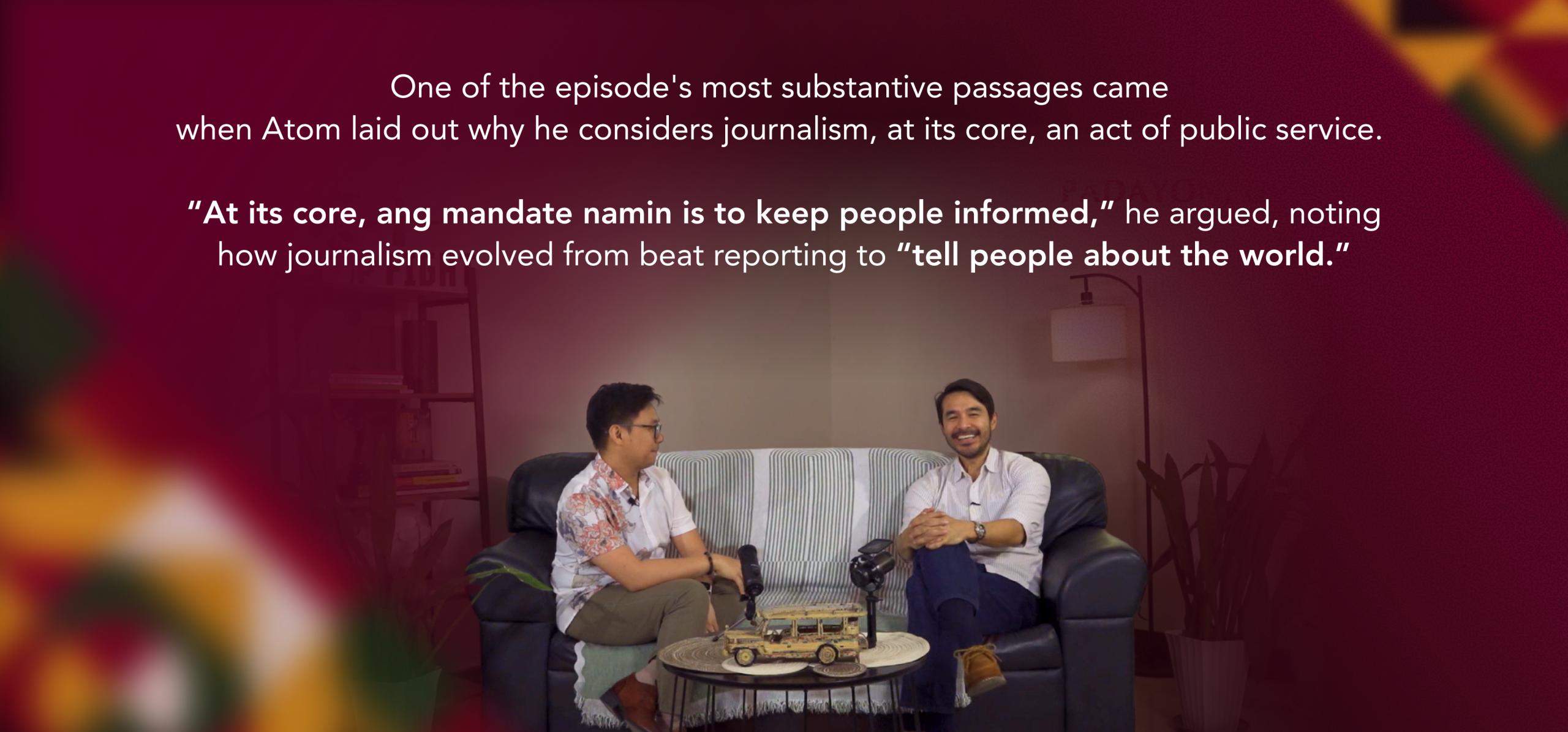
One of the episode’s most substantive passages came when Atom laid out why he considers journalism, at its core, an act of public service. “Ang mandate namin is to keep people informed,” he argued, noting how journalism evolved from beat reporting to “tell[ing] people about the world.” Broadcast journalism, he added, carries an additional dimension that most people overlook. “‘Yung franchise, ‘yung paggamit ng airwaves, ay scarce, it’s public property. Kailangan hindi mo lang siya pagkakitaan kundi mag-provide ka ng service”—warning people about incoming typhoons, directing them to aid after disasters, exposing corruption, and acting as a watchdog.
I represent the people when I go to these places, and I should reflect their interests.”
Atom Araullo, Padayon, UP! Episode 1
He was equally direct about the accountability that comes with the platform. “I represent the people when I go to these places, and I should reflect their interests.” In a media landscape increasingly crowded with unverified voices, he sees a strong value system as non-negotiable: “Kailangan mo ng malakas na values na magiging gabay mo sa nagbabagong mundo ng journalism at ng pamamahayag.”
"PAGLINGKURAN ANG SAMBAYANAN"
For Atom, public service is neither just a slogan nor simple charity, but, in his words, it is “[Ka]simbigat ng bundok ang responsibilidad at ang panawagan.” Genuine service means applying one’s skills toward “meaningful and long-term changes” that break the cycle of intergenerational poverty. However, he is careful not to moralize: “Hindi naman masama na mangarap para sa sarili mo.” But for those privileged with education and a platform, the capacity–and therefore the obligation–runs deeper. “Marami ka pa namang pwedeng gawin.”
He provides a concrete example of this through the story of Oro, a student, sugar cane plantation worker, and athlete, whom he met while filming his documentary. Reflecting on the encounter, Atom shared, “Here’s this guy pursuing his dream, nag-aaral sa school, nagtatrabaho ng napakabigat na trabaho sa plantasyon—parang anong excuse mo?”. Meeting someone like Oro, Atom said, makes the country’s potential impossible to dismiss. “Kung mabibigyan ng oportunidad, maa-unleash [natin] ‘yung kanilang potential.”

The podcast’s closing line, delivered by host Mark Lester, serves as the definitive statement for what Padayon, UP! intends to be: “Mula sa pamantasan hanggang sa bayan — ang layo pa ng ating tatahakin. Marami pa tayong mga pagsubok, [at] suliranin na haharapin. Malalim pa ‘yung mga aral na matututunan natin. Basta tuloy lang. Padayon, UP.”
Atom Araullo is an award-winning journalist and the author of A View from the Ground, published by UP Press. He currently hosts documentary programs such as The Atom Araullo Specials and I-Witness, and serves as the news anchor of GMA News TV’s State of the Nation.
Padayon UP! is a monthly video podcast, hosted and produced by Assistant Vice President for Public Service Mark Lester del Mundo Chico and directed by Gerardo Laydia, Jr. This is an initiative of the Padayon UP Public Service Office which aims to bridge the gap between the university and the nation by highlighting narratives of public service and social impact.
Watch the full episode here:
Cover design and art cards: Gerardo Laydia, Jr.
Photos: Alain Villegas